Friday, 26 February 2010

Crispy Chinese Roast Pork Belly (Siew Yoke/Siobak)

SAM TAN'S KITCHEN HAS MOVED! Please visit the new website/online store at www.samtanskitchen.com for all catering enquiries. You can also follow Sam on InstagramFacebook and Twitter. Thank you!

*Also available cooked-to-order by weight. Please email samtanskitchen@gmail.com for details.


I made this for lunch the other day for the first time after comparing tons of online recipes, and I must say- never have I experienced an atmosphere so electric with anticipation in this house as at the possibility of achieving hawker-standard siew yoke at home.

Thankfully to our collective yelps of delight, the results were just totally, unbelievably perfect! Crisp crunchy golden-orange crackling and succulent just-fatty-enough layers of pork, the entire toppling pile of siew yoke was wiped out between the three of us in no time.

Be warned however- the whole kitchen will smoke up and your entire oven will be covered in oil splatter. It is totally worth it though if you don't mind a bit of cleaning up- the meat truly tastes like it does back home and if Arivind is anything to go by, your nearest and dearest who get to eat it will hail you as God. Funny how much street cred crackling can get you :)

Crispy Chinese Roast Pork Belly (Siew Yoke/Siobak)


Clean 1 kg pork belly and dry thoroughly (I do this by putting the meat skin side down on some kitchen towels after washing).
Stir together the following ingredients to form the marinade:
½ tbsp salt
½ tbsp sugar *optional*
1 large or 2 small cubes nam yue (red fermented/preserved beancurd-available in jars or tins in Asian shops)
½ tbsp five-spice powder
1 tbsp Shaoxing rice wine


Score the flesh part (not the skin) of the pork belly lightly in diagonal lines and rub in the marinade well. Place the joint in a foil-lined roasting tin, marinated side down so it can sit and absorb the flavours.

Score the skin part this time, using a sharp knife and being as thorough as possible. Rub in lots of salt all over, deep into each cut.

Leave the joint uncovered overnight to dry completely. Room temperature is fine in cold climates like London, but you should refrigerate the meat if it's hot where you are.

When ready to cook, lift the joint up and place a flat wire rack underneath to enable fat to drip off into the pan. Pat dry if there is any moisture left on the skin and bake in the middle of a 200C/395 F fan-assisted oven.

After 20 mins, remove and stab the skin all over as much as possible using two forks, one in each hand (I find this much steadier and faster than just using one hand). Drizzle the skin all over with a few tablespoons of rice vinegar.

Return the pan to the oven and switch it to grill/broil setting (upper heat only) at very high heat, about 250C/485 F. You will see the crackling start to bubble and pop wherever you poked with a fork. Grill for a further 30 mins, opening the oven door intermittently to let smoke escape, until the skin gets slightly burnt and charred. Don't worry about the blackened bits- it can be removed easily and is essential to ensure the crackling achieves the correct crispiness.

Once cooked, remove from the oven, scrape off any burnt parts with a serrated knife and leave to rest 15 mins before chopping.

Cheat tip: if any parts of the skin are still soft, just take the joint out of the oven and flip the entire thing upside down onto a large frying pan on the stove, skin side first (you can also cut it into more manageable pieces first if you like). Sear the skin on high heat with no added oil, until everything pops and crisps up. Watch out for oil splutter!

Listen to the satisfying crunch as you cut your siew yoke into chunks.

Save the cleaning up for later and devour with hot steaming rice. Make sure not to leave leftovers- the crackling goes soft when left overnight.

Enjoy!


Monday, 22 February 2010

Homemade Kaya (Malaysian Coconut Egg Jam)

SAM TAN'S KITCHEN HAS MOVED! Please visit the new website/online store at www.samtanskitchen.com for all catering enquiries. You can also follow Sam on InstagramFacebook and Twitter. Thank you!

*Also available made-to-order at $10 per 16 fl oz tub (1 lb/454g)


After several failed attempts trying to make kaya the lazy way (using the jam function of a breadmaker then blending it afterwards), I have resigned myself to the fact that there simply is no shortcut- 75-90 minutes of patience and manual labour are absolutely essential in achieving the right consistency, colour and flavour for this luscious glossy spread. Whilst blending a lumpy breadmaker-made jam may remove its watery scrambled-egg appearance and make it smoother, the texture usually ends up too thin and drippy (due to the excess moisture created by cooking in an enclosed space) or too matte-like and pasty (like peanut butter instead of a shiny curd).

Kaya translates literally to mean "rich" in Malay, and that is precisely what this delicious Malaysian staple is- a thick, sticky, luxurious blend of coconut cream, eggs, and sugar fragranced with the aroma of pandan (screwpine) leaves. The beautiful amber hue is achieved by adding a bit of melted caramelised sugar towards the end- if you prefer your kaya pale then by all means omit this step, and use a touch of pandan paste instead of leaves if desired (though your jam will be a green version).

It's easy but tedious- if you like kaya, have time on your hands and don't mind standing in front of the stove for over an hour (or pull up a chair to sit like I did), then I'd say you're in for a highly rewarding experience :) Happy stirring!

Homemade Kaya (Malaysian Coconut Egg Jam)
Yields 2 cups (16 fl oz/454 g)


Whisk together lightly:
3 whole eggs
2 egg yolks

Stir in 1 cup (200g) caster sugar until completely dissolved.

Stir in
300ml coconut milk, then pour entire mixture through a sieve into a large mixing bowl (to make sure all those lumpy eggy bits are removed).

Add 3-4 pandan leaves, knotted, then plonk your bowl above a pot of simmering water (the bottom of my bowl was submerged in the water) or use a double boiler if you have one.

Cook over low heat for about an hour, stirring continuously.

Stir stir stir stir stir.

Bring a book or laptop if you get bored, but make sure you continue stirring with the other hand.
If it starts getting lumpy, stir HARDER.


After 45 minutes- a teensy bit darker and thicker. I won't lie, as you can see
it takes AGES before any discernable change happens.

After about 75 minutes, dissolve 4 tbsp caster sugar with a bit of water in a separate pan over low heat until a dark golden caramel is formed. I would recommend you switch off the heat a few seconds before it becomes the colour you want, as it will continue browning. Be careful as caramel burns very fast!


Stir the caramel into the hot kaya (it should look golden brown like the picture). Don't worry
if the caramel hardens upon contact- continue cooking and it will eventually dissolve.
Add more darkened caramel if the colour isn't too your liking.


Cook another 10-15 mins until the desired consistency is achieved (remember
it will thicken once cooled). Remove the pandan leaves, scraping off
any kaya stuck to them (nobody likes wastage!)


Let cool, then pour into a jar and store refrigerated. Best enjoyed sandwiched roti bakar style with slabs of butter, or spread on your morning toast, or slathered on crackers or hot waffles or pancakes, or as an accompaniment to sweet sticky rice, or as a dip for breadsticks, or spooned directly into your mouth, or licked off your sticky fingers...


Saturday, 30 January 2010

Traditional Chinese New Year Peanut Cookies (Fah Sang Peng)

SAM TAN'S KITCHEN HAS MOVED! Please visit the new website/online store at www.samtanskitchen.com for all catering enquiries. You can also follow Sam on InstagramFacebook and Twitter. Thank you!

*Also available under Chinese New Year Cookies to Order- $20 per box of 30 pcs


Chinese New Year is 2 weeks away, and having missed out on all the festivities back home for the past 6 years, I decided 2010 was the time to more actively recreate some of the buzz all the way here in London, at least on the baking front.

I urge you SERIOUSLY, even if you're not Chinese and don't celebrate CNY, to try this recipe. If your life's experience of peanut cookies has been limited to chunky Western versions made with peanut butter and a criss-cross fork pattern, these little devils will be a revelation- crisp to the bite, then crumbly as you first chew, then melt-in-the-mouth, then unbelievably fragrant as the salty nutty flavour hits your tongue. Well-made fah sang peng are an exercise in taste and textural heaven akin to a cross between buttery shortbread and melting moments, except better, because of the added oomph and aroma of peanuts. :)

The recipe below is simple and easy too, the only slightly time consuming bit being the shaping of the cookie with a bottle cap. Most people choose to add more oil so they can roll the dough into smooth solid balls- I prefer to keep the pastry short and crumbly, and I like the rustic and uneven end result with the little cracks around the edges. Just beware- once baked, you'll have one (just to try), two (just to be sure), and before you know it you'd have had thirty.

Don't say I didn't warn you :)

Traditional Chinese New Year Peanut Cookies (Fah Sang Peng)
Makes about 60 cookies, depending on the size of your bottle cap

Blitz 200g roasted salted peanuts in a blender/spice mill until a finely ground powder/paste is formed.
*Note: I used a ready-to-eat Asda Smartprice pack (which was insanely cheap, only 27p!) that was already roasted, salted and had added vegetable oil, hence a more pasty rather than powdery result. If you prefer you can use raw nuts and dry fry/roast from scratch, but remember you'll be adding salt and oil later anyway.

In a large bowl, sift together:
200g (approx. 1 1/2 cups) plain flour
100g (approx. 3/4 cup) icing sugar (essential for the fine texture- do not substitute with normal sugar)
1/2 tsp baking powder
Dash of salt (more if you used unsalted nuts)

Chuck everything into a food processor (or a mixing bowl if kneading manually), add a good glug of vegetable oil- I used rapeseed, but any mild variety like corn, sunflower or groundnut will do- and blend at high speed (or work with your fingers) until a crumbly, dry, short dough that looks like this is formed:


If the mix is still floury, add more oil gradually and keep blending/kneading until the "grainy sand" look (like shortcrust pastry before liquid is added) is achieved, and forms a solid tightly packed mass if compressed. Be sure not to pour in too much oil at one go- you don't want a greasy mess.


To shape each cookie, place a piece of cling film over a clean bottle cap
(I used the plastic top of an HP sauce bottle, about 3cm wide and 1.5 cm deep)
and press in dough tightly. Yank out the cling film to release the cookie and place on a lined baking sheet. Repeat until all dough is used up.

Using the back of a spoon, brush each cookie with a bit of egg wash (1 egg yolk diluted with 1 tsp of water).


Bake at 160 C fan-assisted (or 180 C for non-convection ovens) for 20-25 minutes until golden brown.

Let cool, then devour!:)


Sunday, 24 January 2010

Little Hanoi Vietnamese Restaurant

Little Hanoi Vietnamese Restaurant 22 January 2010
147 Curtain Road
The City
London EC2A 3QE
Tel: 0207 729 6868

Rule no. 1 at this little family-run institution: stay away from the bog-standard Chinese trappings on the menu, get head waiter Michael Luong to help you order correctly and your tastebuds are in for the feast of their lives! Super-talented chef Phai (Michael's father) dishes up mouthwatering, robust Vietnamese dishes using the freshest of seafood, meat and vegetables paired with the most flavourful of herbs and spices that will leave you salivating for more.

Located above the club Plastic People on Curtain Road (near but not on the "Pho Mile" that is Kingsland Road), there is no doubt whatsoever that Little Hanoi more than holds its own. I will leave the pictures to speak for themselves :)


STARTERS

Grilled Scallops on Shell (£10.50 for 4 pcs- they looked so good Arivind ate one before I could take a picture!)- DIVINE, an absolute must-try. Topped with crunchy peanuts and a luscious tangy sauce,
no wonder some call it the best scallops in London!

Fresh Summer Rolls (£3)- packed with prawns, crunchy lettuce and carrots with a
thick hoisin dip. Good and generous, but pales in comparison to the
scallops (but then again most things would...)

King Prawn Sweet Potato Pancake (£6.80)- fabulously fried,
crisp and crunchy on the outside and chewy inside.

MAINS

Grilled Venison (£12)- Mmm mmm MMM! So tender, so moist, so deliciously charred
yet sweet yet peppery all at the same time... a true work of art. Little Hanoi claims to be
the only place that serves this divine creation in the whole haven of Viet cuisine
that is Shoreditch- if that isn't reason enough to go I don't know what is!

Grilled Salmon in Banana Leaf (£12)- Praise. The. Heavens. OMG. I thought the
scallops and venison were my favourites, till waiter Michael plonked this gorgeous
melt-in-the-mouth slab of perfectly cooked flaky pink goodness with a beautiful
fragrant sauce in front of us. Totally SUBLIME with hot steamed rice.

A new discovery in July 2010- Phai's genius creation of deep fried giant scallops with Parma ham.
Priced the same as the previous scallop dish if I'm not mistaken.

Vietnamese Pork Chops (portion here shown for table of 10, can't be certain of the price as it was for a party)-
grilled to sweet succulent perfection

Some crab dish (again for a table of 10)- no idea what it's called but it comes with a
mouthwatering spicy sweet gravy!

Vietnamese pho- personally I still prefer Song Que's version of this, but Phai's
is delicious and comforting nonetheless.

Little Hanoi don't do desserts (traditionally the Vietnamese finish meals with fresh fruit or liquor), but you can rest assured you'd be too stuffed anyway to want anything else. If you have the opportunity to give 24-hours notice in advance of your visit, I would also highly recommend these two other specialities which they are happy to arrange for you on special order as long as you call beforehand:

Dover Sole Boat (£50)- fleshy chunks of dover sole served on a crispy "boat"
made of the fish's skeleton, deep-fried til it's crunchy and edible

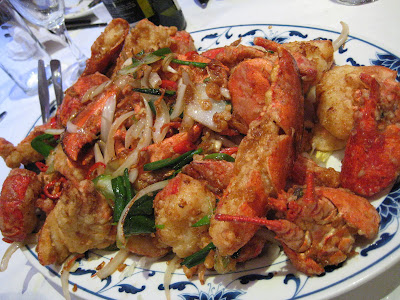
Lobster (£70)- can't remember the exact name sorry, but it is YUM.

If you've previously walked into Little Hanoi for nothing more than their cheap lunch buffet or Chinese standards, I implore you to return and go for the ala carte specialities as this is where their true strengths lie. Good food at good prices- GO TRY IT!

Yummy in our tummy!:)