Friday, 23 July 2010

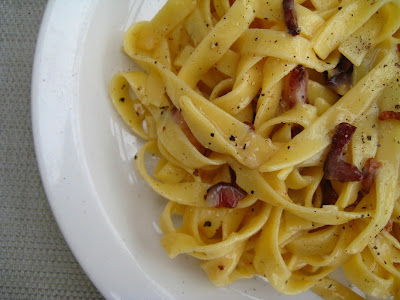
Tagliatelle alla Carbonara


Dieters look away! With its full-fat, calorie-laden combination of white carbs tossed with bacon fried in butter swirled with a creamy cheesy sauce, carbonara is the dish to expand waistlines if ever there was one.

For the rest of us who choose not to care however, it is a devilishly easy-to-make, uncomplicated plate of luscious goodness that epitomises the gorgeous simplicity and flavour of Italian cuisine. Did you know that truly authentic carbonara made the proper way actually contains no cream, but achieves its richness from beaten eggs and melted parmesan? No complex sauce made separately either- the raw eggs and cheese are simply tossed with freshly cooked hot pasta to cook in its residual heat.

Traditionally only egg yolks are used, but my dislike for wastage means that the recipe below includes the whites as well. Thick long varieties such as tagliatelle, fettucine, linguine or spaghetti are particularly well-suited for this sinfully luscious dish, but feel free to use whatever pasta you desire.

For convenience' sake, the quantities listed are for one relatively hungry person- increase and multiply as needed.

Tagliatelle alla Carbonara
Serves 1

In a small bowl, whisk together 1 egg with about ½ cup grated Parmigiano Reggiano/ Pecorino Romano (parmesan). Set aside.


Boil 100g tagliatelle/fettucine/spaghetti (I used dried- if using fresh cook for a shorter time) in salted water for 10-15 mins or until al dente.

Meanwhile, fry 50g chopped pancetta/bacon in 1 tsp butter and some extra virgin olive oil until browned.


Drain the pasta. Chuck it in a large pot/bowl and toss immediately whilst hot with the egg cheese mix and cooked bacon (along with some of its buttery oily juices!). Season well with a touch of salt (not too much as the bacon is already salty) and freshly ground black pepper. Cover and leave to sit for 5-10 mins to cook in its own residual heat.

Garnish with chopped parsley or a sprinkle of grated Parmesan if desired and serve.


Monday, 12 July 2010

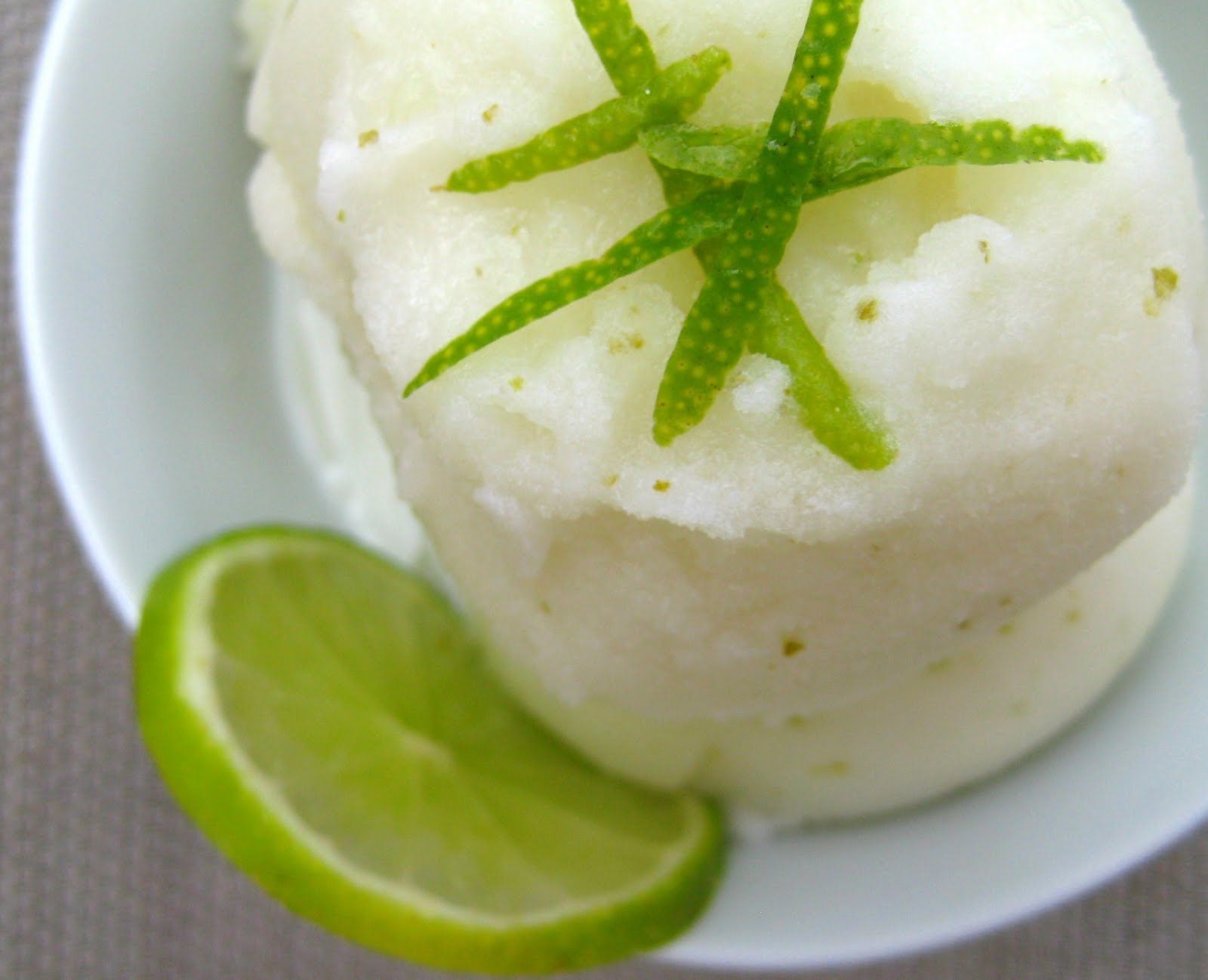
Smooth Homemade Lime Sorbet (Without An Ice Cream Maker)

SAM TAN'S KITCHEN HAS MOVED! Please visit the new website/online store at www.samtanskitchen.com. You can also follow Sam on InstagramFacebook and Twitter. Thank you!


The perfect zesty lift to zing you up and cool you down this sweltering summer, the following recipe is ludicrously easy and just requires some patience and time as you freeze-blend-refreeze several times. The end result though, is well worth the wait- a smooth, soft, tart, beautifully refreshing sorbet made WITHOUT a special ice cream machine, guaranteed to impress! :)

One whisked egg white makes all the difference, the essential ingredient that gives this frozen dessert the body and silkiness it needs.

Make at least 12 hours before you intend to eat it- if it seems too hard, leave at room temperature for 5 mins before scooping. Serve immediately as it melts rapidly.


Smooth Homemade Lime Sorbet (Without An Ice Cream Maker)
Makes about 1 litre

Stir together and dissolve over medium heat to form a thin sugar syrup:
500ml (2 cups) water
250g sugar

Let cool, then stir in the juice and zest of 6 large limes.

In a separate large bowl with an electric mixer, whisk 1 large egg white until a stiff meringue (ensure the bowl and whisk are clean and dry). Pour in the lime syrup liquid and continue whisking until the egg whites are incorporated (they may float to the top- don't worry as you will be stirring it again once frozen).

Chuck into a container and put in the freezer. After about 3 hours, scrape down the frozen sides and stir thoroughly with a metal spoon. Refreeze for another 3 hours.

Remove and pour the entire contents into a juice blender (an electric whisk doesn't make it smooth enough in my opinion). Blend until very smooth- depending on your blender, you may need to do it in small batches or use a spoon to push down the sides to get the icy mixture moving (be careful not to touch the moving blades). Pour back into the container and freeze until firm.

Scoop and decorate with lime zest or some mint leaves if desired. Eat immediately.

Saturday, 3 July 2010

Grilled Sweet Miso Salmon with Ginger

An easy-peasy Japanesey dish if ever there was one, and very good for you too! :)

Grilled Sweet Miso Salmon with Ginger
Serves 4

Rinse and pat dry 4 medium skin-on salmon fillets.

Stir together in a bowl and spread all over the fish:
3 tbsp white miso paste
2 tbsp honey
1" fresh ginger, minced
1 tbsp sake
Dash of rice vinegar
Dash of sesame oil

*I leave out soy sauce and salt as the miso paste is already salty

White miso paste

Stirring the ginger into the marinade

The coated fillets

Place in fridge to marinate at least half an hour (the longer the better).

To cook, arrange the fillets skin side down on a foil-lined tray and place under an oven grill at 180 C for about 5-8 mins. Flip over and continue grilling a further 5-10 mins or until the skin turns crispy and caramelises.

Garnish with a sprinkling of toasted sesame seeds, and serve immediately alongside some hot rice and steamed vegetables.


Monday, 21 June 2010

Marisa's PERFECT Hainanese Chicken Rice

SAM TAN'S KITCHEN HAS MOVED! Please visit the new website/online store at www.samtanskitchen.com. You can also follow Sam on InstagramFacebook and Twitter. Thank you!


Those that know me well will know that whilst I love a lot of different foods, I Love Hainanese Chicken Rice.

That's right, Love, with a capital L, in Bold, and Italicised. Actually, it's more like LOVE, or LOOOOOVE if lengthening a word with extra vowels and typing it in Caps Lock increases the meaning of it.

It is the one and only dish that I could happily eat every meal, every day forever and still request as my last before I die, the sole chart-topper in the (long) list of Yummy Grub Sam Has Loved Since She Was Yay High And Makes Kinky Orgasmic Noises Eating. So you can only imagine how I felt about my good friend, insanely-talented-cook and all-round foodie queen Marisa when I discovered how stupendously, phenomenally, deliciously perfect her version of it was.

Marisa, I LOOOOOVE you! *big hug*

Wonderful Makcik Marisa (makcik means Auntie in Malay, and it's our term of endearment for her because she cooks like the kind of old-school aunt who is able to churn out the most stonking traditional dishes, no matter how complex, all from memory) has generously agreed to let me share her amazing kai fan (chicken rice) recipe here on my blog. As is typical of a makcik she doesn't weigh or measure anything, so all the amounts provided below are my interpretations of what she means by "a bit of", "some" and "quite a lot" after some trial and error.

If you are not from Malaysian/Singapore/Hainan and unfamiliar with the beautiful concept of Hainanese Chicken Rice, think of it as a little tripartite of gourmet harmony: Part 1- poached/steamed chicken infused with the delicate flavours of ginger and spring onion then drizzled with light soy sauce and sesame oil, Part 2 a mouthwatering aromatic rice cooked in the tasty stock created from steaming the chicken, and Part 3 the accompanying condiments- a fresh ginger dip, a light garlic chilli sauce and a thick dark soy sauce (or if you're from Hainan, oyster sauce mixed with minced garlic)- that round off the entire exquisite package for your palate perfectly. Oh and of course there's a Part 4 to the equation if you choose to have it- a bowl of hot, steaming clear chicken broth. Result: culinary sublimity.

The popular Cantonese version from my mother's hometown of Ipoh typically serves chicken rice with pork meatball soup and blanched beansprouts (hence it being called nga choy kai fan or Ipoh beansprout chicken rice), whilst Singaporeans insist that a good variation must have "jelly"- the under-skin fat that solidifies into a clear gel when the chicken is served stone cold- in order to be authentic. Others refer to it as "Hailam" chicken rice and not "Hainanese"- whatever the case, if ever you're ordering it in a restaurant just ask for pak cham kai fan (white chopped chicken rice) and you're in safe territory :) Click here for a more detailed rundown of the regional variations of this divine creation than I could ever hope to write.

Maybe it's just me choosing to ignore that it's the chicken fat making everything taste good, but aside from its deliciousness I do believe Hainanese chicken rice is far healthier than many of its fried, oily, sugary, santan-laden Malaysian hawker counterparts.

You know, just in case you, like, needed an extra reason to eat this or something.

Marisa's PERFECT Hainanese Chicken Rice
Serves 4-6


Best bargain EVER- got this entire 375g bag of reduced-price ginger ends from

Asda for £0.04!


First of all, blend 150g fresh ginger to a paste (you should get about 4 heaped tbsp). Put aside about 3 tbsp to be used later for the ginger sauce/rice.


  • PART 1- THE CHICKEN
Rub lots of salt and the remaining 1 tbsp ginger paste all over 1 large (approx. 2kg) whole chicken, preferably cornfed (for firmness and texture). If you only have chicken legs or portions lying around you can use those instead, but be sure to adjust cooking time and be prepared for a less accurate result.


The ginger-and-salt rubbed chicken

Combine 1.5 litres water with 8 spring onions, finely chopped (white parts only) in the base of a large steamer. Bring to a boil and steam the chicken for about 45 mins (much less if you're using portions) over medium heat. The chicken is cooked when its juices run clear.

Leave the chicken to cool thoroughly before chopping into pieces. This is essential so that the skin has a chance to firm up and prevent the meat shredding apart when you cut it. Stir together some light soy sauce and sesame oil and drizzle generously over the meat. Garnish with fresh coriander leaves or thinly sliced spring onions.

*Garnishing tip- to make the spring onions curl, slice them into very thin strips and soak briefly in cold water.


  • PART 2- THE RICE


Wash and drain 4 cups uncooked long grain white rice (1/2 cup rice per person is usually already a generous portion- this will make enough for seconds).

Blend together to a paste and stir in until well dispersed amongst the rice grains:
1 tbsp of ginger paste
1 medium onion, finely chopped
4 cloves garlic
Salt to taste
1 tsp sugar *optional

Add
1 pandan (screwpine) leaf, knotted. Top up with chicken stock from the steamer until the liquid level is about 1" above the rice. Cook as per usual.
  • PART 3- THE CONDIMENTS

Ginger sauce

Saute in a small saucepan for a few minutes:
2 tbsp ginger paste
2 tbsp oil
Salt to taste

Stir in some finely chopped spring onions if desired. Allow to cool before using.
Chilli garlic sauce

Blitz together:
50g fresh large red chillies (about 4 medium)- make sure to deseed them if they are super-hot like the large chillies you get in the UK!
3 cloves garlic
2 tbsp rice vinegar
Salt
1 tbsp sugar

Serve about 1 teaspoon of each sauce per portion of chicken rice, along with a teaspoon of thick dark soy sauce/cooking caramel- Marisa and I both recommend the Cheong Chan brand (red label, made in Malaysia).
  • PART 4- THE SOUP
Season the chicken stock from the steamer well with white pepper and salt. If desired, add some fishballs/pork balls and blanch for a few mins until cooked.

Serve steaming hot with a sprinkling of
dried shallots or finely chopped spring onions (the green part).

Say a few words of thanks and eternal gratitude to Marisa, dig in to your homemade kai fan and savour the goodness!

Wednesday, 9 June 2010

Sago Gula Melaka (Sago Pearl Pudding with Palm Sugar and Coconut Milk)


Like a cold, tropical fusion between sticky rice pudding, creme caramel and a bouncy jelly, this quintessential Malaysian favourite combines the spongy spring of moulded sago pearls with the richness of santan (coconut milk) and the fragrant sweetness of palm sugar (gula melaka) to form a decadent yet refreshing dessert, particularly well-suited for cooling you down after a spicy meal.

For those who are unfamiliar, sago pearls are tiny dry opaque white balls practically identical to tapioca pearls (see picture below). Both turn translucent and soft when soaked and cooked, and more often than not you can use them interchangeably as I do with this recipe. Occasionally instead of white you'll find pearl sago artificially dyed green, red or multiple other colours- personally I prefer my sago in its original form, but they taste the same so feel free to use those if bright desserts are your kind of thing. Do not, however, attempt to substitute gula melaka (pictured below) unless utterly desperate- not molasses, Thai palm sugar or even Indian palm jaggery can quite compare to the glossy darkness and rich woody flavour of Malaysian (or more specifically, Malaccan) palm sugar.


Be sure to make everything at least 4 hours before serving so they have a chance to chill thoroughly.

Sago Gula Melaka (Sago Pearl Pudding with Palm Sugar and Coconut Milk)
Serves 12

  • Making the Sago
Soak 200g sago/tapioca pearls in water for 5 mins, then drain.


Raw sago/tapioca pearls

Bring 5 cups of water to boil in a large pot* with 1 knotted pandan (screwpine) leaf (for added flavour and fragrance). Gradually dribble in the soaked sago, stirring constantly to avoid clumping. Boil on low heat for 10 mins until almost translucent, then switch off the heat, cover and let sit in the residual heat a further 10 mins until completely transparent.

* If desired, throw in 

The half-cooked, almost translucent sago

Top up the pot with cold tap water (to make it less gummy) and pour the mixture carefully through a fine metal sieve. Rinse under cold running water whilst stirring with a spoon-the clear sago grains will be quite hard to spot initially but will emerge once all the liquid drains.

*Washing up the sieve is no fun as all the gloopy excess starch will be stuck to it, but use a good scrubber and lots of soap/hot water and it shouldn't take too long.


The drained sago pearls

Stir in a generous pinch of salt and 1/3 cup sugar, then pour into slightly wet individual moulds/cups/serving bowls (having them damp makes it easier to unmould later on) or a large casserole dish if you prefer to have people scoop their own portion. Refrigerate until set.
  • Dissolving the Gula Melaka (the shortcut way)


Gula melaka in its typical cylindrical form

Place a 200g gula melaka block (you will only use a fraction of this for the sago but they tend to come at roughly this size) with 3/4 cup water into a bowl. Some recipes say to grate/shave/chop the block first- don't bother as it melts just as easily from whole, and makes no difference whatsoever to the end result!

Microwave on maximum heat at 2-3 min intervals, stirring carefully and breaking the block into smaller chunks with a spoon as it starts to soften. Be very careful as boiling syrup can cause serious burns. Repeat as many times as necessary, stirring in between until it totally dissolves to form a dark and glossy syrup. If desired, sieve to remove any grit (though I never bother as it will settle at the bottom anyway). Refrigerate until completely cold- if your syrup looks too runny, don't fret as it will thicken once chilled.
.
*If you don't own a microwave, you can dissolve it the traditional way in a pot over low heat on the stove. As usual make sure to stir constantly to prevent burning.

  • Making the Santan (skip this step if you're not bothered about adding pandan flavour)
Combine in a small pot and simmer over low heat, stirring constantly:
100ml fresh coconut milk (do not substitute with powder)
A pinch of salt
1 pandan (screwpine) leaf, knotted

Once it starts bubbling, remove from heat and let the santan cool. Discard the pandan leaf and refrigerate until cold.

To serve, unmould the puddings and serve with a generous drizzle of both toppings. Ensure there is plenty of extra so people can top up to their own taste. Dig in!